How the red king crab walked into Kirkenes
The crab you pull out of the fjord near Kirkenes is a Pacific animal that arrived through a Soviet experiment. Its story explains why Norway fishes it hard, why biologists keep an eye on it and why it ended up as a tourist meal. Below, the crab itself, from its first release to the trap.
A Pacific crab in Arctic Norway
The red king crab, Paralithodes camtschaticus, does not belong in Norway. Its home is the North Pacific, along the coasts from Kamchatka across to Alaska, where it has long been fished for its legs.
Yet the crab in a trap below a pier in Kirkenes is that same Pacific species. It reached the fjords of eastern Finnmark through a deliberate human plan, not by drifting across an ocean.
Released near Murmansk in the 1960s
In the 1960s Soviet scientists released red king crabs in the Murmansk area, on the Barents Sea coast east of the Norwegian border. The goal was a new and valuable fishery in waters that had never held these crabs.
The crabs settled in and multiplied. Over the following decades they spread west along the coast, and Norwegian fishermen began to find them in their nets off eastern Finnmark.
Kirkenes sits a few kilometers from the Russian border, on the Bøkfjord, an arm of the Varangerfjord. That placed the town right in the path of the crab's slow march west, which is how a Soviet project turned into a Norwegian dinner.
Why biologists worry about it
The red king crab eats almost anything it can find on the seabed. In the cold water of the Barents Sea it has grown into a large population, and few local animals can tackle a full-grown adult.
That is the textbook profile of an invasive species. Researchers worry about what heavy feeding does to life on the sea floor, and that concern shapes how Norway treats the animal.
So the safari sits in an unusual spot. You help harvest an animal that biologists would rather see fewer of, and if you feel uneasy about eating something you just watched come out of the water, that context may help.
Two sets of rules for one crab
Norway manages the king crab in two broad ways, depending on where it lives. In the east, around the Varangerfjord, a regulated fishery with quotas treats the crab as a resource to keep.
Further west the approach flips. There fishing is largely free, with the aim of slowing the crab's spread down the Norwegian coast. The details shift from time to time, so read this as the broad picture rather than a rulebook.
For a visitor the practical effect is simple. The Kirkenes safari runs in the managed eastern waters, and the operator, Snow Resort Kirkenes, sets its pots in the fjord ahead of each trip.
Ten legs and one bigger claw
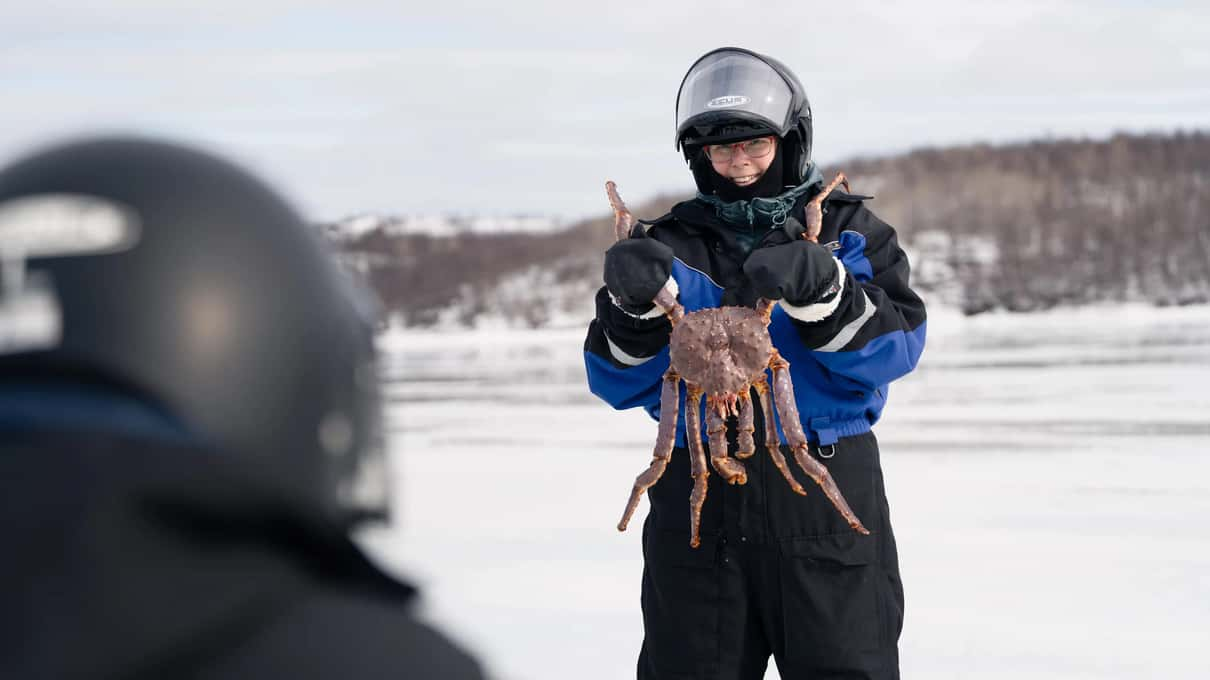
When the guide holds a crab up, you can count the parts yourself. There are six long walking legs and two claws, and one claw is clearly larger than the other.
A small extra pair of legs usually sits tucked under the back of the shell. That is why books give the king crab ten legs while you mostly see eight.
Big ones can span well over a meter (about 3 feet) from leg tip to leg tip and weigh up to about 10 kg (22 lb). Most crabs in a trap are smaller, and no guide can promise you a giant.
The shell is thick and covered in spikes. The mittens in the operator's kit help when you hold one for a photo, which both trips include.
From pest to restaurant plate
King crab leg meat is sweet and firm, and it sells for high prices around the world. That turned the crab into an export business for fishermen in eastern Finnmark and, later, into a reason for travelers to come north.
Tourism added a second use for the same animal. Instead of ordering crab legs in a restaurant, you ride out to the traps and watch them come up. The crab is cooked Northern Norwegian style and eaten afterwards.
Our guide to the crab meal and how much of it you get covers what lands on the plate and how the legs are served.
Watch the pots come up from the fjord
The summer RIB trip hauls the crab pots from an open boat and ends with the catch in a boathouse across the water. Viator reviewers give it 5.0 (50 reviews), GetYourGuide reviewers 4.8 (34).
Meeting one on a safari
In summer you meet the crab on the deck of a RIB, as the pots come up from deep water. The summer RIB safari from ~$284 also stops at local fishing boats, where the guide explains the king crab fishery alongside traditional fishing.
In winter the traps come up through a hole in the fjord ice. The winter ice safari from ~$376 reaches them by sled behind a snowmobile, and the guide talks through the biology and history of the crab out on the ice.
Either way, every crab you pull up is headed for the pot. Go in expecting a fishing trip that ends in lunch rather than a nature tour.
Our RIB trip from pier to plate and the ice trip with its sled ride show how each day runs. Still deciding? The boat or ice comparison sets them side by side, and our guide to timing says when each one goes out.